The Next Industrial Revolution: Who Will Benefit, and How Should We Adapt?
What the Industrial Revolution, NVIDIA's vision and recent AI adoption data can teach us about navigating technological change.
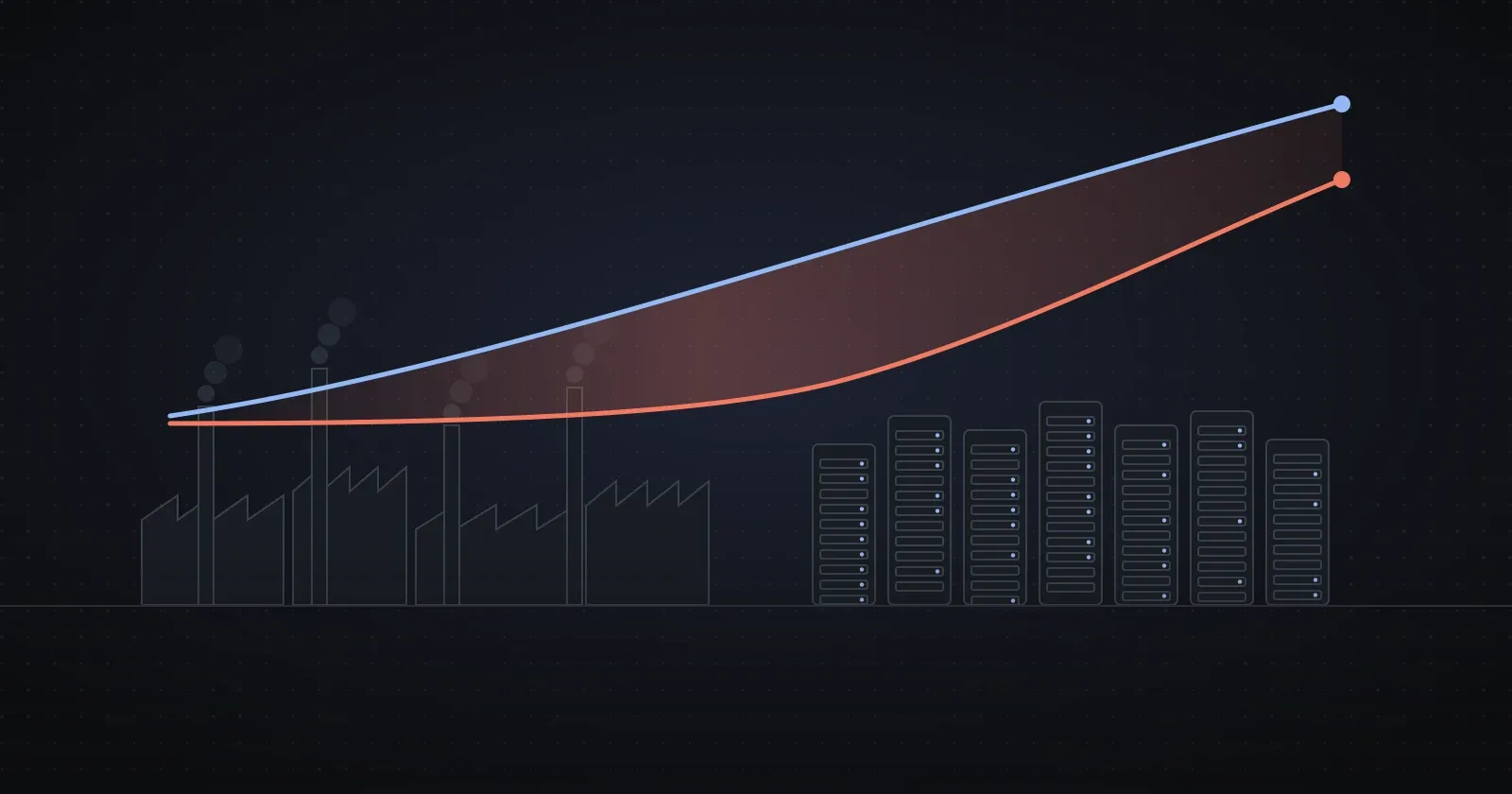
At NVIDIA GTC Berlin in October 2026, Jensen Huang described AI as the beginning of another industrial revolution.
His vision goes far beyond chatbots and productivity tools. He describes an entirely new economic infrastructure built in layers: energy, computing, AI factories, models and applications.
He also made a point aimed at his European audience: to take part in this economy, Europe should aim to produce AI rather than merely consume it.
NVIDIA obviously has a strong commercial interest in promoting this vision. But it raises a question worth exploring: if AI transforms the economy as profoundly as industrialization did, who will actually benefit?
Did the Industrial Revolution create more jobs?
The usual argument is straightforward. Machines replaced manual labor, new industries appeared, employment shifted, and the economy ultimately became far more prosperous.
There is truth to that. Industrialization transformed the structure of employment. Over time, workers moved from agriculture into manufacturing and services, and new occupations emerged.
But the transition took generations, and its benefits were distributed very unevenly.
The economic historian Robert Allen describes a period known as Engels’ Pause. In Britain during the first half of the 19th century, output per worker increased while real wages stayed largely flat. Profits grew, and capital owners captured a larger share of national income. Only later did wages begin to grow more closely in line with productivity.
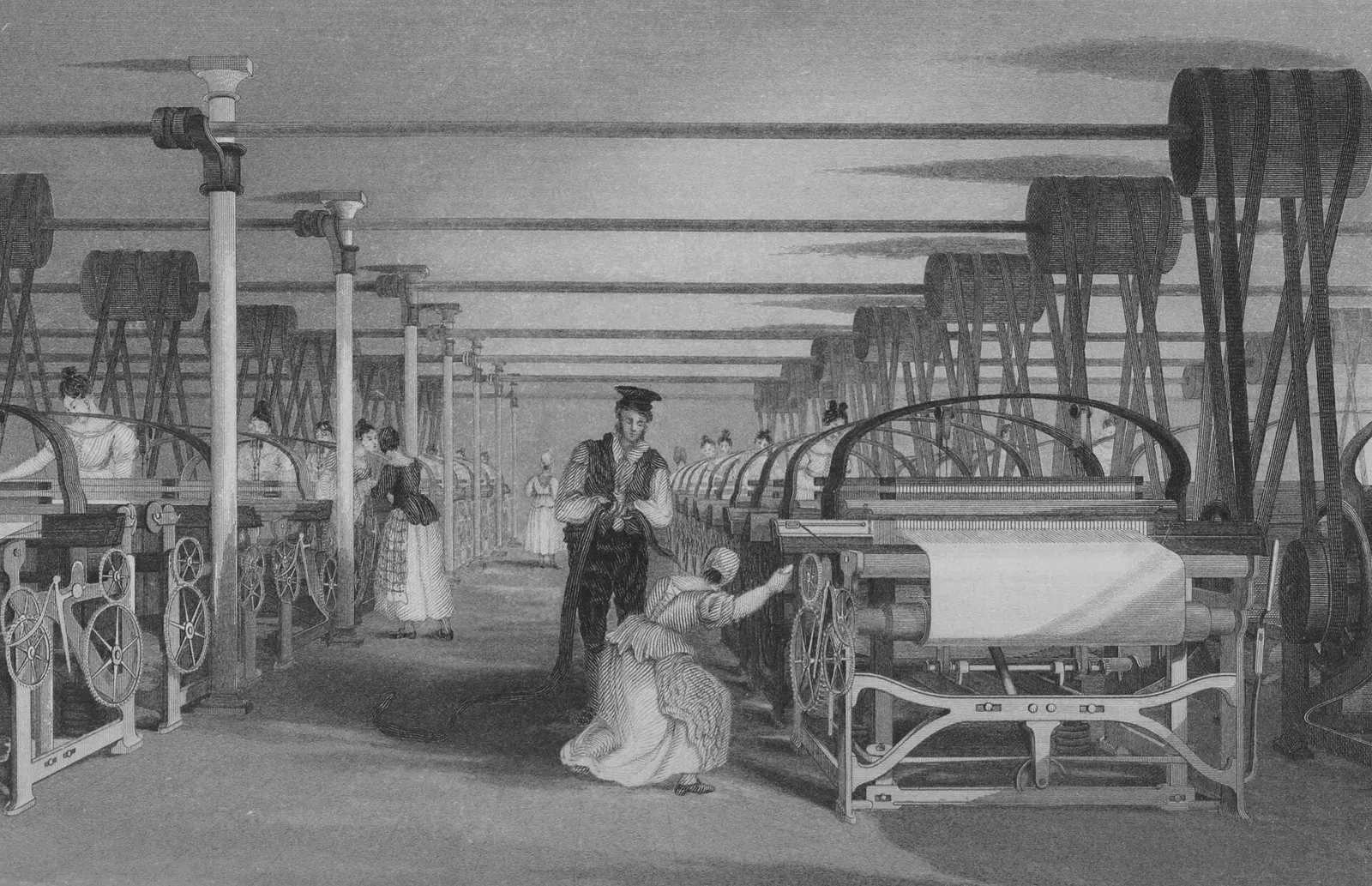
Power-loom weaving in 1835. Every loom is belted to overhead shafts turned by a single steam engine. Engraving by T. Allom and J. Tingle, from Edward Baines’ History of the Cotton Manufacture in Great Britain. Public domain, via Wikimedia Commons.
This detail is often missing from comparisons with today’s AI revolution. The economy eventually became much wealthier, but that didn’t mean workers benefited from mechanization straight away. Some occupations declined, working conditions were often harsh, and the adjustment was neither quick nor painless.
Nor can we count the jobs created by steam engines and subtract the jobs they eliminated. Population growth, expanding markets, changing demand and many other factors shaped employment.
History shows that economies can reorganize around new technologies. It doesn’t show that every technological revolution creates more jobs than it destroys.
AI productivity is growing. Where are the economic gains?
An interesting parallel appears in McKinsey’s State of AI in 2026 survey. 80% of respondents said AI had improved their individual productivity, yet only 37% reported any positive contribution from AI to their organization’s operating earnings (EBIT).
These are self-reported survey results, not a measurement of productivity or a prediction of employment. Still, they point to a meaningful gap: making individual tasks easier doesn’t automatically turn into measurable financial gains for the organization.
McKinsey argues that companies often need to redesign entire workflows, rather than insert AI tools into existing processes, to capture the broader benefits. In a separate article they estimate that coordination (handoffs, checking, routing work between people) takes 35 to 60 percent of working time in knowledge-intensive organizations. Speeding up the individual steps leaves most of that untouched.
There’s a historical parallel here too. As Paul David showed in The Dynamo and the Computer, when factories moved from steam power to electricity, the big gains didn’t come from swapping one central power source for another. They came decades later, once factory layouts and production processes were redesigned around small electric motors at each machine.
AI may require a similar organizational transformation.
And even if companies do become substantially more productive, another question remains: how will those gains be distributed among employees, customers and capital owners? Productivity growth alone doesn’t answer it.
Will AI create more jobs than it replaces?
I don’t think we have enough evidence to answer that confidently.
AI differs from earlier automation in several ways. It can perform cognitive tasks, speed up software development, assist with analysis, and increasingly carry out complex workflows end to end.
New occupations and industries are likely to emerge, but we don’t know whether they will absorb displaced workers quickly enough.
And unlike most earlier machines, AI can potentially automate part of the work of building and operating other automated systems. That may accelerate technological change and make the transition harder.
There are also reasons to expect new demand. As services become cheaper, more people and businesses may use them, creating additional economic activity.
The outcome will depend on how quickly the technology improves, how organizations adopt it, how demand responds, and which economic policies are introduced. I wouldn’t assume either mass unemployment or an effortless transition to new jobs.
How should we adapt?
We can’t control the pace of technological progress, but we can improve our ability to respond to it. I would focus on three things.
1. Develop transferable capabilities
Learning new tools and frameworks is useful, but I wouldn’t build an entire career around one technology.
Understanding systems, solving practical problems, evaluating trade-offs and recognizing where technology creates value give you more room to move. These skills can be partly automated too. The advantage is being able to move between technologies rather than depending on a single one.
2. Build financial resilience
The Industrial Revolution reminds us that higher productivity doesn’t guarantee immediate wage growth.
Keeping savings, investing consistently and avoiding excessive financial commitments can give you more freedom during an uncertain transition.
Not everyone can build substantial reserves. That’s one reason individual preparation can’t replace broader economic and social policy.
3. Build access to opportunities
Professional relationships, reputation and an understanding of how organizations work can matter as much as expertise in a particular technology.
I would pay attention to how new tools change industries, what problems they solve, and where new opportunities appear. When a better technology replaces an existing solution, recognizing and adopting the improvement is usually worth more than defending the old one.
A lesson worth remembering
Jensen Huang’s vision of a new AI economy may turn out to be broadly right. We may see entirely new industries, products and ways of working.
But the Industrial Revolution teaches us to separate technological progress from the distribution of its benefits. McKinsey’s findings add another reminder: even turning technological capability into measurable business value takes time and organizational change.
None of this tells us what employment will look like in ten or twenty years. At an individual level, I think the most reasonable approach is to preserve flexibility: develop transferable expertise, improve financial resilience, and keep access to new opportunities.
I wouldn’t bet my future on predicting which technology wins. I’d rather build a position that lets me benefit from technological progress regardless of the winner.
References
- NVIDIA, GTC Berlin 2026 keynote (October 2026).
- McKinsey, The State of AI in 2026: On the Road to ROI (2026).
- McKinsey, Cutting the coordination tax: How agentic AI can reshape workflows (2026).
- Robert C. Allen, Engels’ Pause: Technical change, capital accumulation, and inequality in the British industrial revolution, Explorations in Economic History 46(4), 2009.
- Paul A. David, The Dynamo and the Computer: An Historical Perspective on the Modern Productivity Paradox, American Economic Review 80(2), 1990.